According to the Ministry of Industry and Trade, the export market for the wood industry has undergone significant changes. While previously focusing on transit markets such as Taiwan, Singapore, and South Korea for re-export to third countries, Vietnamese wood products are now directly exported to 120 countries.
The growth momentum in major markets such as the US, EU, Japan, and China continues to be maintained, while expanding into potential and emerging markets.

Wood industry businesses are stepping up export activities.
Market diversification
According to Mr. Nguyen Ton Quyen, Vice President of the Vietnam Wood and Forest Products Association (VIFORES), in the first three months of 2019, wood exports averaged US$750 million per month, an average increase of US$100 million per month compared to previous years. Prior to that, in 2018, the value of Vietnam's wood and forest product exports reached US$9.38 billion – officially surpassing seafood to become the most valuable export item in the agricultural sector. According to VIFORES, the main reasons driving the growth of the wood industry stem from trade agreements such as the Vietnam-Korea Free Trade Agreement (VKFTA), the Vietnam-EU Free Trade Agreement (EVFTA), and the Comprehensive and Progressive Trans-Pacific Partnership (CPTPP),…
With a market accounting for 13.5% of global GDP and encompassing nearly 500 million people with total trade exceeding US$5 trillion, joining the CPTPP will bring significant opportunities for Vietnam's wood industry through tariff reductions. Specifically, some partners without existing trade agreements with Vietnam will eliminate most tariffs on furniture, office, and kitchen products immediately upon the CPTPP's entry into force. Accordingly, 321 tariff lines on wood products imported into Peru will be eliminated after 6 years, while the remaining 501 tariff lines from Mexico will be eliminated within a maximum of 10 years.
Mr. Dien Quang Hiep, Chairman of the Binh Duong Wood Processing Association, shared that in the context of a promising market, the CPTPP acts as a "lever" to further boost this industry. He predicted that not only in 2019, but also in the coming years, wood export orders will continue to increase.
According to the Ministry of Industry and Trade, the wood industry's export market has undergone significant changes recently. Previously, the focus was on transit markets such as Taiwan, Singapore, and South Korea for re-export to third countries. Now, Vietnamese wood products are directly exported to 120 countries. The growth momentum in major markets like the US, EU, Japan, and China continues, while also expanding into potential and new markets. Notably, the wood industry has seen increased consumption in new markets such as Canada, the Eurasian Economic Union, and South Asia, particularly for bedroom, dining, and living room furniture, as well as classic-style decorative wood products.
Experts believe that although Vietnam's wood processing industry is still not on par with leading exporters from Germany, Italy, and Poland—whose products are in the high-end segment and their production lines are almost 100% automated—the Vietnamese wood industry is gradually gaining market share in these countries.
Innovation in production technology
While acknowledging the vast opportunities in the wood industry, businesses also frankly pointed out the challenges that the industry needs to address, such as the need for significant capital to upgrade machinery and improve production capacity to meet large orders. Mr. Nguyen Quoc Khanh – Chairman of the Ho Chi Minh City Handicraft and Wood Processing Association – stated: “The Vietnamese wood industry has only utilized about 30-40% of its domestic resources. Many resources remain untapped, such as the efficiency of technology investment, improved management, investment in design, distribution, brand building, etc… everything that hasn't been done yet could be an opportunity for businesses as they develop.”.
On behalf of the Binh Duong Wood Association, Mr. Dien Quang Hiep emphasized: “We are a highly competitive country because no other country has achieved such rapid growth in the Vietnamese wood industry. However, our growth rate comes from relying on brute force and quantity to compete, while developed countries invest in design, branding, automation technology, modern factories, etc. Vietnam must address this issue to accelerate the sustainable development of the industry.”.
The wood manufacturing and exporting business community believes that "genuine production and genuine sales" create healthy competition. This explains why, in other countries, good products are produced at good prices, even high prices, yet consumers still buy them because they feel they are worth the price. This model is still new in Vietnam. Vietnam has many traditional craft villages, but the trend is to produce cheap goods with unregulated quality, while large manufacturing enterprises focus on processing goods for export.
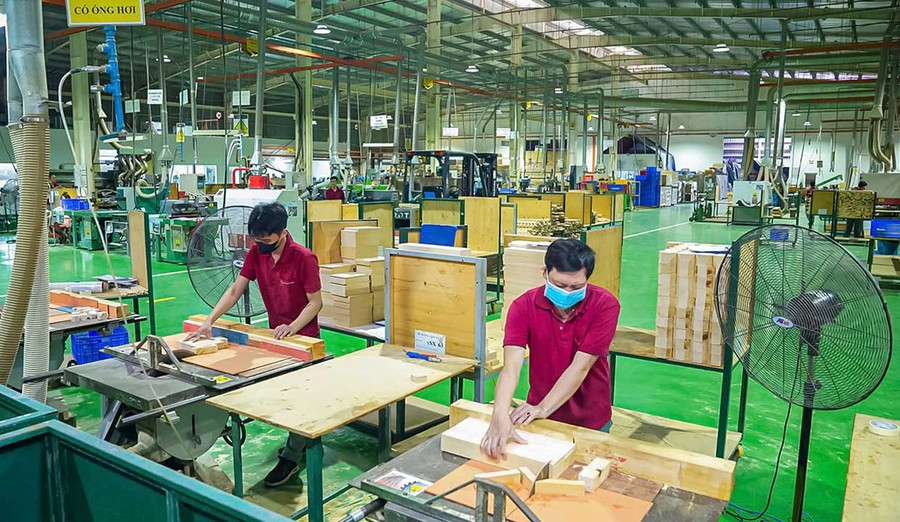
According to experts, businesses need to focus on investing in and applying automation in production, adopting new management technologies, and improving the quality and skills of workers to reduce costs and increase labor productivity. In addition, businesses need to strengthen cooperation, establish and form supply chains from raw material production to export to improve the efficiency of the supply chain by concentrating resources on specialization, reducing transaction and production costs, and enhancing business efficiency.
With a large and promising market, increasing productivity is essential. Ms. Do Thi Kim Loan, General Director of Sao Nam Trading & Manufacturing Co., Ltd., stated that with the goal of achieving $20 million in exports in 2019, the company has invested in many modern machinery and equipment systems to increase labor productivity, reduce costs, and meet the order requirements of various markets. Not only her company, but many wood industry businesses are now proactively investing in modern technology and equipment; upgrading designs towards convenience and uniqueness; and changing business management models, etc., in order to increase their competitiveness in the international market.