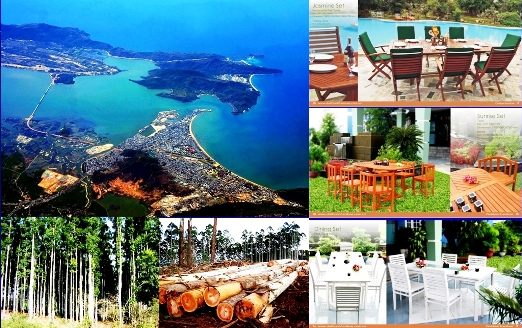
Strengths of Gia Lai's wood processing industry
- Gia Lai has over 135 km of coastline and a well-developed transportation network including National Highway 1A, National Highway 14, and National Highway 19 – vital arteries connecting to the Central Highlands, Southern Laos, and Northeastern Cambodia; the North-South unified railway; air transport; and especially Quy Nhon seaport, one of the three seaports with the largest cargo throughput in Vietnam. It serves as a hub for importing raw materials and exporting wood products not only for Gia Lai but also for the Central and Central Highlands regions, opening a wide door for the wood processing and export industry in Gia Lai and its raw material producing areas to access the global market.
- Gia Lai has over 295,105 hectares of planted forest, meeting a portion of the raw timber needs for export production and significantly supplementing the readily available imported timber from around the world. A rudimentary raw material market, established decades ago, features nearly 100 reputable domestic and international businesses, meeting stringent European environmental standards.
- Gia Lai has a traditional workforce engaged in wood processing since ancient times. Workers are trained to a high standard and are becoming increasingly professional to meet industrial production demands. Wood processing is a key industry in Gia Lai, and the provincial leadership consistently prioritizes vocational training for workers, creating a high-quality and stable workforce for factories.
- Các nhà máy chế biến gỗ đều tập trung tại các khu công nghiệp lớn như KCN Phú Tài, KCN Long Mỹ, KCN Nhơn Hòa, và hàng chục cụm công nghiệp khác tạo điều kiện thuận lợi cho khách hàng trong việc đặt hàng cũng như quản lý đơn hàng.